
Industry-news
Ultrasonic Scaler Tips Compatibility: EMS, Satelec, DTE & Woodpecker | SinaDental
Ordering replacement ultrasonic scaler tips by model number alone often leads to loose fits, weak vibration, overheating, or tips that won't lock at all. This is the most common complaint in the scaler accessories category, and it almost always comes down to compatibility.
The handpiece brand matters more than the tip shape. A G1T from one maker is not guaranteed to match a G1T from another, even when both claim "EMS compatible." Here is what actually determines fit.
Why Tips Are Not Universally Interchangeable
Piezo scaler tips follow several competing designs rather than a single global standard. Four factors determine whether a tip works in your handpiece:
Thread pitch and profile. The internal thread must match exactly in pitch, diameter, and depth. A near-match thread may screw in partway but loses energy at the joint.
Shank diameter and length. Even a fraction of a millimeter changes how the tip seats. Too deep and it bottoms out; too shallow and it loosens during use.
Amplitude matching. Piezo handpieces are tuned for tips of specific mass and length. Heavier or longer tips reduce oscillation, making the scaler feel weak at maximum power.
Locking design. Some systems screw in; others use push-fit with a retaining nut. Mixing the two will not work.
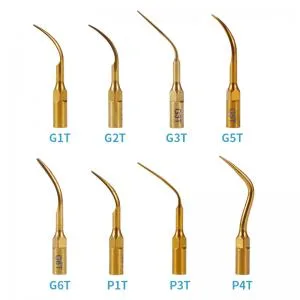
The Major Tip Systems
EMS / Satelec-compatible. These Swiss and French brands share a similar screw-in thread that has become the most widely copied standard worldwide. It covers standard perio inserts (G1T, G2T, G3T), endo tips, and implant designs. Because so many factories produce to this pattern, quality varies considerably between suppliers.
DTE-compatible. DTE uses its own thread specification and is not interchangeable with EMS or Satelec handpieces. Woodpecker units generally follow the DTE system, though some newer models accept EMS-type tips. That exception is exactly why you must verify by model number rather than by brand name.
Magnetostrictive systems (Parkell, Hu-Friedy). These use stack-based inserts instead of screw-in piezo tips. They are not compatible with any piezo system.
Signs Your Tips Are Not Compatible
Incompatible tips often still attach to the handpiece, which delays diagnosis. Watch for weak scaling power at high settings, excessive heat at the handpiece nose, tips loosening during use, unusual rattling, fracture at the shank, or error codes from the unit.
If any of these appear, stop using the tips. Poor coupling can damage the handpiece's ceramic crystals, turning a cheap consumable problem into an expensive repair.
How to Verify Compatibility Before Ordering
First, identify your handpiece model exactly by checking the label on the handpiece body and noting whether it is piezo or magnetostrictive. Second, measure an original tip that you know fits, recording overall length, shank diameter, thread type, and wrench size. Third, request a cross-reference chart; a supplier who cannot provide one is a warning sign. Fourth, order a trial quantity and test seating feel, vibration at mid power, heat after two minutes of continuous use, and whether the tip stays tight. Finally, confirm the return or exchange policy before committing to bulk.
Does Brand Affect Performance?
Two tips that fit the same handpiece can still perform differently. Variables include the alloy, thread machining precision, balance of the working end, and surface finish. A well-made tip transfers vibration cleanly and resists fatigue over hundreds of autoclave cycles. A poorly made one may fit perfectly yet feel sluggish or fracture at the neck. Price-per-unit comparisons here are often misleading.
For distributors, the practical approach is to stock the highest-volume shapes for your dominant system — usually EMS/Satelec-compatible G1T and G2T — keep finer and specialty tips as smaller-volume items, and label clearly which handpiece family each group fits.
Care and Sterilization
Rinse debris from the threads and working end immediately after use, then autoclave at standard 134°C cycles. Do not stack tips loosely where they can strike each other, and avoid pliers or excessive torque when installing, since overtightening damages threads. Retire any tip showing bending, pitting, corrosion at the thread, or visible wear.
Tip compatibility depends on thread design, shank dimensions, and amplitude tuning, not on model number labels. Verifying your handpiece model, requesting a cross-reference chart, and testing a trial batch prevent nearly all fit problems.
At SinaDental, we manufacture piezo scaler tips to precise dimensional standards for EMS/Satelec-compatible and DTE-compatible systems, including G1T, G2T, G3T and a full range of perio, endo, implant, and specialty tips. We provide a compatibility cross-reference chart with every order and support trial quantities so you can verify fit before going bulk.
Explore our ultrasonic scaler accessories or with your handpiece model for a compatibility check and current pricing.
FAQ
Q: Are EMS and Satelec tips interchangeable?
A: They share the same screw-in thread family and are generally cross-compatible, but dimensions vary slightly between manufacturers. Verify against your specific handpiece model.
Q: Can I use DTE tips in an EMS handpiece?
A: No. The thread specifications differ, and using the wrong system risks damaging the handpiece.
Q: Why does my new tip feel weaker than the original?
A: Most often a mismatch in tip mass or length affecting amplitude transfer, or incomplete thread engagement. Check both.
Q: How long do ultrasonic scaler tips last?
A: There is no fixed schedule. Replace them when cutting efficiency drops, or when you see deformation, thread corrosion, or fracture at the neck.
RELATED NEWS
- Dental Carbide Bur vs Diamond Bur: Pros, Cons & When to Use | SinaDental
- FG vs RA Carbide Burs: What's the Difference? | SinaDental
- Piezo Scaler Inserts Explained: G1T, G2T, G3T Selection Guide | SinaDental
- Dental Carbide Burs Complete Guide: Types, Shapes & Applications | SinaDental
- Dental Prophy Brushes: Types, Selection & Best Practices | SinaDental
CATEGORIES
LATEST NEWS
- Ultrasonic Scaler Tips Compatibility: EMS, Satelec, DTE & Woodpecker | SinaDental2026-09-24
- Dental Carbide Bur vs Diamond Bur: Pros, Cons & When to Use | SinaDental2026-09-23
- FG vs RA Carbide Burs: What's the Difference? | SinaDental2026-09-22
- Piezo Scaler Inserts Explained: G1T, G2T, G3T Selection Guide | SinaDental2026-09-18
- Dental Carbide Burs Complete Guide: Types, Shapes & Applications | SinaDental2026-09-17
CONTACT US
Name: Cassiel
Mobile:+8618320745852
Tel:+8618320745852
Email:info@sinadentmedical.net
Add:Room 207,Building 8,HongHua Road, No. 25,Gongming District, Shenzhen City, GuangDong Province.