
Industry-news
Dental Air Scaler vs. Ultrasonic Scaler – Which Is Right for You? | SinaDent
When it comes to professional dental scaling, two main technologies dominate the market: ultrasonic scalers and dental air scalers. Both are effective at removing plaque and calculus, but they work differently and suit different clinical situations.
Here's what you need to know to choose the right one for your practice.
1. How They Work
Ultrasonic scalers use electrical power to generate high-frequency vibrations (typically 25,000–42,000 Hz) at the tip, combined with a water spray to flush away debris.
Dental air scalers, on the other hand, are pneumatic instruments powered by compressed air from the dental unit. They produce oscillating movements at the tip (around 6,000 Hz) for gentle yet effective scaling.
2. Key Differences at a Glance
| Feature | Dental Air Scaler | Ultrasonic Scaler |
|---|---|---|
| Power source | Compressed air | Electricity |
| Tip oscillation | ~6,000 Hz | 25,000–42,000 Hz |
| Noise level | Quieter | Louder |
| Heat generation | Low | Moderate to high |
| Patient comfort | Generally higher | Variable |
| Maintenance | Simpler, fewer electronic parts | More complex |
3. Advantages of Dental Air Scalers
Gentle on patients – The lower oscillation frequency and minimal heat generation make air scalers ideal for patients with sensitive teeth or gum issues.
Quiet operation – Reduced noise means less stress for both the dental team and patients.
Lightweight and ergonomic – Easy to handle, reducing operator fatigue during lengthy procedures.
Cost-effective – Fewer electronic components mean lower maintenance costs and longer service life.
Effective plaque removal – Studies have shown air scalers can remove approximately 80% of plaque.
4. When to Choose Each
Choose a dental air scaler when:
Patients have sensitive teeth or gums
You prioritise patient comfort and quiet operation
You want a low-maintenance, cost-effective solution
You perform routine prophylaxis and light to moderate scaling
Choose an ultrasonic scaler when:
You need to remove heavy, tenacious calculus deposits
You perform deep subgingival scaling regularly
Your practice handles high-volume, complex periodontal cases
5. Clinical Applications of Dental Air Scalers
Dental air scalers are suitable for:
Routine dental prophylaxis and cleanings
Periodontal maintenance for patients with a history of gum disease
Gentle subgingival scaling
Minimally invasive procedures where preserving tooth structure is a priority
6. Maintenance Tips
To keep your dental air scaler performing at its best:
Lubricate regularly with turbine oil
Sterilise properly after each use
Clean the external surface thoroughly
Check for vibration, noise, or overheating before each use
Replace worn components promptly
Why Choose SinaDent?
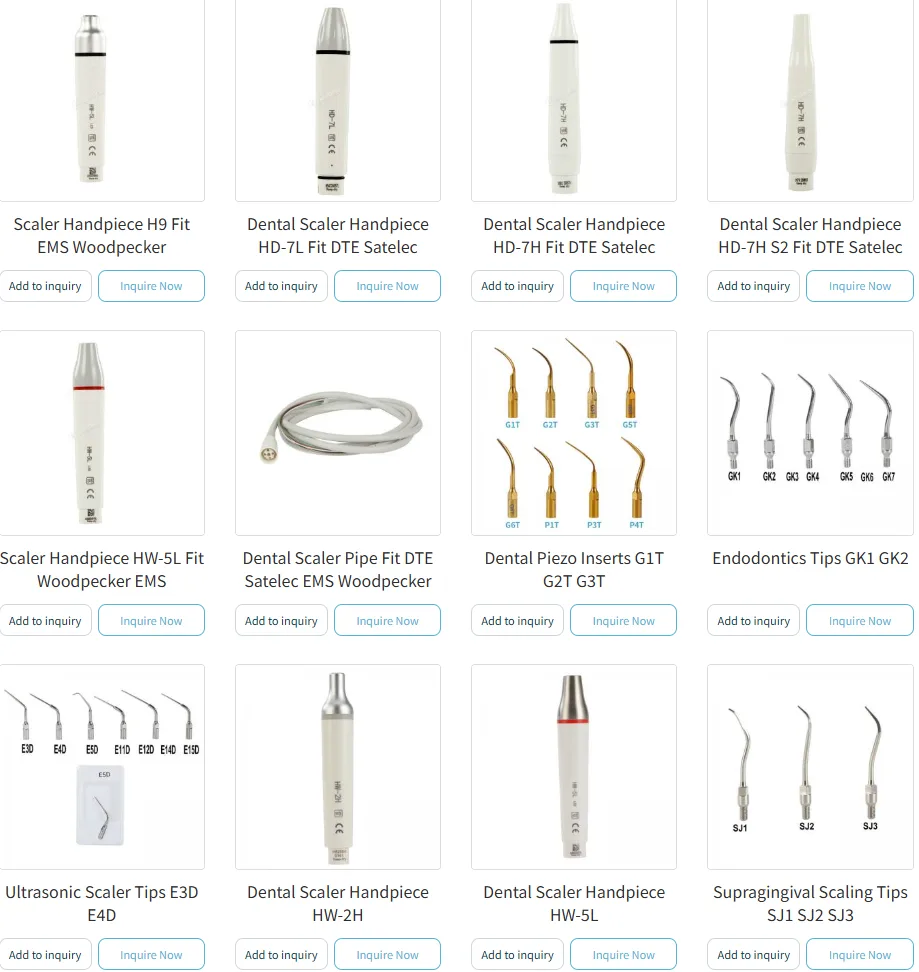
Shenzhen SinaDent Medical Supplies Co., Ltd. is a professional manufacturer of dental air scalers and ultrasonic scaler tips. Our dental air scaler offers precise control for gentle yet effective scaling, enhancing patient comfort in daily practice.
Key benefits:
Durable, cost-effective solutions for dental professionals
Compatible with standard dental units
Reliable performance in clinical settings
Professional support from a trusted manufacturer
Both air scalers and ultrasonic scalers have their place in modern dentistry. If patient comfort, quiet operation, and low maintenance are your priorities, a dental air scaler is an excellent choice. For heavy calculus removal and deep periodontal work, ultrasonic scalers remain the standard.
Looking for a reliable dental air scaler for your clinic? Contact SinaDent today.
RELATED NEWS
- Dental Clinic Equipment Starter Kit – What to Include | SinaDent
- Dental Products Manufacturer Direct Factory Price – What It Means | SinaDent
- Woodpecker UDS-E Compatible Tips – EMS Thread Guide | SinaDent
- Dental Instruments Wholesale – What to Check | SinaDent
- How to Choose Dental Equipment for Your Clinic | SinaDent
CATEGORIES
LATEST NEWS
- Dental Clinic Equipment Starter Kit – What to Include | SinaDent2026-10-16
- Dental Products Manufacturer Direct Factory Price – What It Means | SinaDent2026-10-15
- Woodpecker UDS-E Compatible Tips – EMS Thread Guide | SinaDent2026-10-14
- Dental Instruments Wholesale – What to Check | SinaDent2026-10-13
- How to Choose Dental Equipment for Your Clinic | SinaDent2026-10-12
CONTACT US
Name: Cassiel
Mobile:+8618320745852
Tel:+8618320745852
Email:info@sinadentmedical.net
Add:Room 207,Building 8,HongHua Road, No. 25,Gongming District, Shenzhen City, GuangDong Province.