
Industry-news
Dental Carbide Burs Complete Guide: Types, Shapes & Applications | SinaDental
Dental carbide burs are among the most essential cutting instruments in restorative and prosthetic dentistry. Made from tungsten carbide, these burs deliver precise, efficient cutting on tooth structure, existing restorations, and prosthetic materials.
Choosing the right carbide bur directly affects cutting efficiency, surface finish, and procedural time. This guide covers the key types, shapes, and applications to help you make informed selections.
What Makes Carbide Burs Different
Unlike diamond burs that grind through abrasion, carbide burs cut using rotary blades — similar to a drill bit. The intersecting flutes shear away material in chips rather than dust, producing faster cutting on softer materials like dentin and composite, cleaner margins with less vibration, and smoother preparation walls compared to diamond burs.
FG vs RA: Understanding Shank Types
Before selecting a bur shape, you need to match the shank to your handpiece.
FG (Friction Grip) burs have a 1.6 mm diameter and are held by friction in high-speed handpieces. They operate at high RPM and are the standard choice for cavity preparation and crown reduction.
RA (Right-Angle latch) burs have a 2.35 mm diameter and latch into low-speed contra-angle handpieces. They are used for controlled, slower-speed work such as caries removal and finishing.
Cutting Blade Configurations
The number of blades determines cutting behavior:
6-blade — Faster cutting, rougher finish. Ideal for bulk reduction.
8-blade — Standard configuration. Balanced speed and smoothness.
12-blade — Finer finish. Used for finishing cavity walls and refining margins.
30+ blade — Ultra-fine cuts for final margin refinement.
Rule: Fewer blades = faster cutting, rougher finish. More blades = slower cutting, smoother finish.
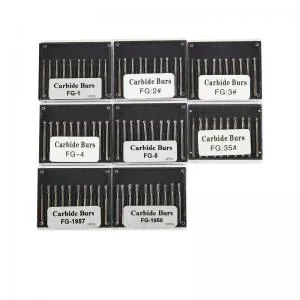
Common Carbide Bur Shapes
Round Burs (#1/4 to #8)
Primarily for gaining access and removing caries. Small rounds (#1/4–#2) for initial entry and caries excavation; larger rounds (#4–#8) for extending outline form and bulk removal.
Inverted Cone Burs (#33.5–#36)
Create flat floors and sharp internal line angles. Essential for flattening pulpal floors, creating retentive undercuts, and removing overhanging restorations.
Straight Fissure Burs — Plain Cut (#245, #56, #57, #700 series)
Produce flat walls with sharp line angles. The workhorse for outline form, wall preparation in Class I/II cavities, and crown reduction. The 700 series (tapered) is especially popular for crown preparation.
Straight Fissure Burs — Cross-Cut (#556, #557, #558)
Intersecting blades create more aggressive cutting. Best for rapid bulk reduction, sectioning teeth, or removing old restorations.
Tapered Fissure Burs (#169–#171)
Walls converge toward the tip. Used for crown preparations requiring taper, beveling margins, and creating divergent walls for indirect restorations.
Flame / Football / Pear Burs
Rounded, tapered shapes for finishing axial walls, rounding internal line angles, and creating retentive features in inlay/onlay preparations.
Carbide Burs vs Diamond Burs
The key difference lies in cutting action: carbide burs shear material with blades, while diamond burs grind through abrasion. Carbide burs perform best on dentin, composite, and amalgam, producing smoother preparation walls. Diamond burs excel on harder, brittle materials like enamel, ceramic, and porcelain, and are preferred for margin refinement and ceramic adjustment.
In practice, most clinicians use both — carbide burs for bulk preparation and diamond burs for fine margin work.
Selection Quick Reference
For initial caries removal, use a round bur #2 or #4. For cavity outline form, reach for a straight fissure #245 or #56 in FG shank. For crown reduction, the tapered fissure #700 series (FG) is the standard choice. For flat floor creation, an inverted cone #33.5 or #34 works best. For margin refinement, step up to a 12-blade or 30-blade finishing bur. For removing old amalgam, a cross-cut fissure #556 or #557 provides the aggressive cutting needed.
Understanding the relationship between bur shape, blade count, and shank type allows you to match the right instrument to each step — from initial access to final margin refinement.
At SinaDental, we manufacture a full range of dental carbide burs in FG and RA shank types across all standard shapes. All burs are produced from premium tungsten carbide with precise blade geometry for consistent cutting performance.
Explore our carbide bur collection or to discuss bulk ordering and OEM specifications.
FAQ
Q: How do I know when a carbide bur is dull?
A: A dull bur requires more pressure, generates more heat, and produces a rougher surface. If the bur is "skating" rather than cutting, it is time to replace it.
Q: Can carbide burs be sterilized and reused?
A: Yes. Carbide burs can be autoclaved at standard 134°C cycles. Inspect cutting blades before each use and replace any bur with chipped or worn blades.
Q: Why does my carbide bur clog during use?
A: Clogging occurs when cut material adheres to the blade flutes. Use adequate water coolant, avoid excessive pressure, and clean bur flutes between uses.
RELATED NEWS
- Dental Prophy Brushes: Types, Selection & Best Practices | SinaDental
- Endo Files – Stainless Steel & NiTi Rotary Systems | SinaDent
- Dental Burs: Choosing the Right Tool for Cavity Preparation & Crown Removal
- Dental Carbide Burs – 330, FG-557, FG1957 & More | SinaDent
- HW-3H vs. HW-5L – Which Scaler Handpiece Is Right for You? | SinaDent
CATEGORIES
LATEST NEWS
- Dental Carbide Burs Complete Guide: Types, Shapes & Applications | SinaDental2026-09-17
- Dental Prophy Brushes: Types, Selection & Best Practices | SinaDental2026-09-16
- Endo Files – Stainless Steel & NiTi Rotary Systems | SinaDent2026-09-15
- Dental Burs: Choosing the Right Tool for Cavity Preparation & Crown Removal2026-09-11
- Dental Carbide Burs – 330, FG-557, FG1957 & More | SinaDent2026-09-10
CONTACT US
Name: Cassiel
Mobile:+8618320745852
Tel:+8618320745852
Email:info@sinadentmedical.net
Add:Room 207,Building 8,HongHua Road, No. 25,Gongming District, Shenzhen City, GuangDong Province.