
Industry-news
Dental Prophy Brushes: Types, Selection & Best Practices | SinaDental
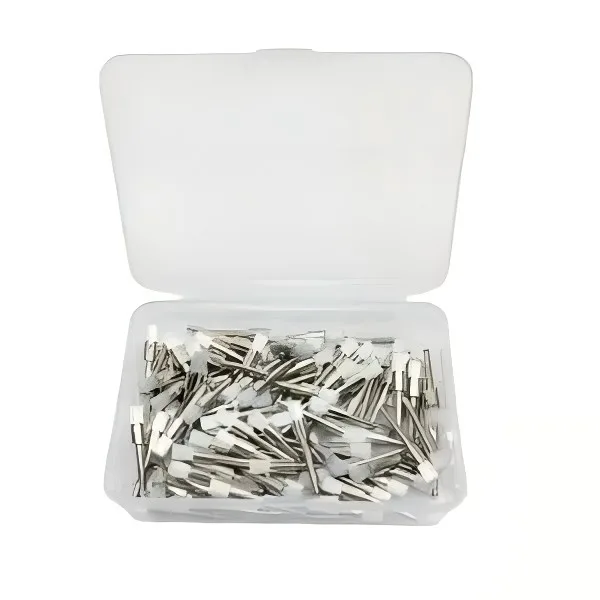
Tooth polishing is a critical step in every prophylaxis appointment. After scaling removes calculus and plaque, polishing smooths the enamel surface, reduces future biofilm adhesion, and improves patient comfort. The dental prophy brush is the primary tool that delivers these results.
Despite their simple appearance, prophy brushes vary significantly in shape, bristle material, and stiffness — each designed for specific clinical situations. This guide covers the essentials you need to choose the right brush and use it effectively.
Why Polishing Matters
After scaling, the tooth surface is left with microscopic irregularities. If unpolished, these rough areas become sites for rapid plaque re-accumulation and stain deposition. Proper polishing smooths enamel, removes residual extrinsic stains, and extends the cleanliness achieved during scaling.
Types of Dental Prophy Brushes
Prophy brushes are categorized by head shape, which determines how they contact the tooth surface.
Cup (Bowl-Shaped) Brushes
The concave bristle arrangement cradles convex tooth surfaces and holds polishing paste for even coverage. This is the go-to brush for routine prophylaxis on buccal and lingual surfaces — gentle on enamel and efficient on broad areas.
Flat Brushes
A straight bristle profile delivers stronger scrubbing power than cup brushes. Best for heavy extrinsic staining (tobacco, coffee, tea) and smoothing surface roughness before restorative procedures. Avoid prolonged use on exposed dentin.
Tapered (Cone-Shaped) Brushes
A narrowing tip reaches into interproximal spaces, deep fissures, and around orthodontic brackets — areas that cup and flat brushes cannot access effectively.
Pointed (Pen-Tip) Brushes
An even more pronounced narrow tip for extremely tight areas: deep occlusal grooves, lingual concavities of anterior teeth, and tight interproximal contacts.
Bristle Materials & Stiffness
Materials
Nylon — The most common choice. Durable, flexible, and available in various stiffness levels. The standard all-rounder for daily prophylaxis.
Natural (Boar/Wool) — Softer than nylon, holds paste well, produces a high-gloss finish. Ideal for sensitive teeth and the final polishing step.
Abrasive-Impregnated — Built-in abrasive particles reduce the need for separate polishing paste, cutting splatter and streamlining workflow.
Stiffness Levels
Soft — Sensitive teeth, exposed dentin, implant surfaces, pediatric patients
Medium — Routine prophylaxis, the standard default for most adult patients
Firm — Heavy tobacco/coffee staining only; never use on exposed dentin or inflamed tissue
Rule of thumb: Start softer and increase stiffness only when needed.
Shank Compatibility
Most dental prophy brushes use an RA (Right-Angle) latch-type shank (2.35 mm diameter) for slow-speed contra-angle handpieces — the universal standard for intraoral polishing. Always confirm shank compatibility before purchasing.
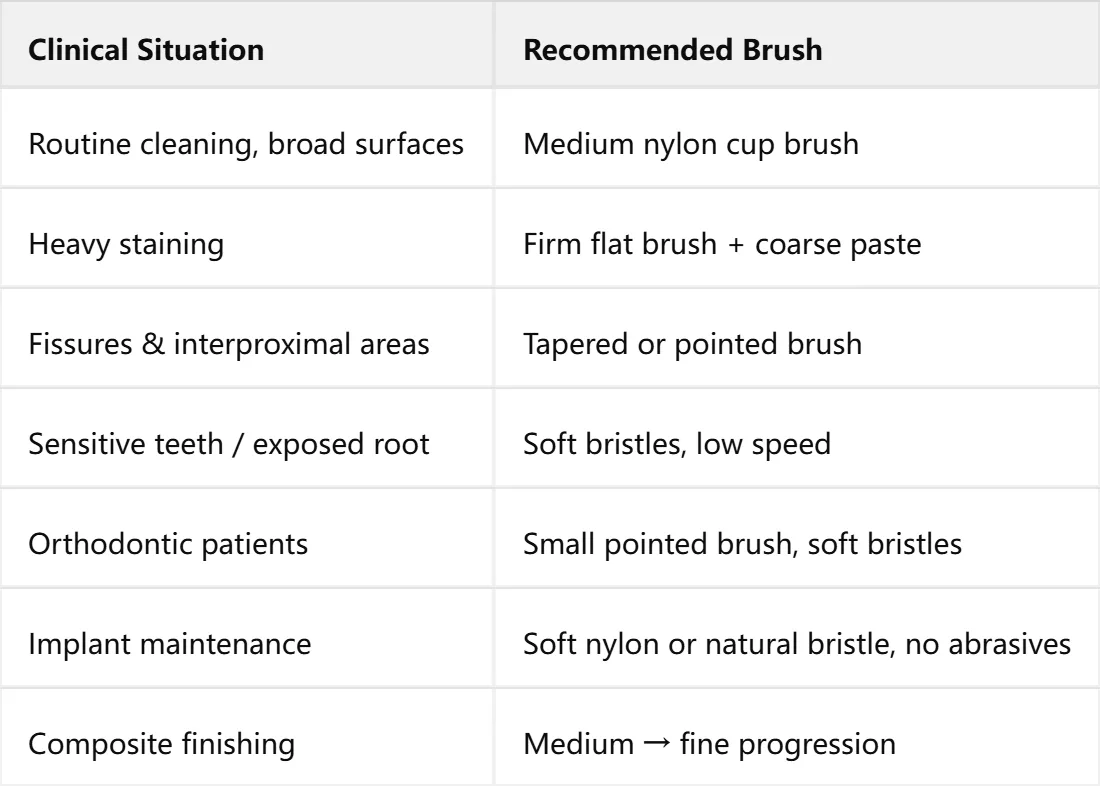
How to Select the Right Brush
Best Practices for Use
Speed: Operate at 2,000–5,000 RPM. Higher speeds generate excessive friction heat that can damage the pulp or soften restorations.
Pressure: Use light, intermittent pressure — let the bristles and paste do the work. Excessive pressure causes gingival trauma and enamel wear.
Technique: Apply a pea-sized amount of paste. Polish 1–2 teeth at a time, ~2–3 seconds per surface. Keep the brush in constant motion to prevent heat buildup.
Wet vs. Dry: Wet polishing (with paste lubrication) is the default. Reserve dry polishing for the final glossing step on composite only.
Care & Sterilization
Rinse thoroughly after use to remove paste residue
Autoclave at standard 134°C cycle (most quality brushes with metal shanks are compatible)
Inspect before each use — replace brushes with splayed, frayed, or missing bristles immediately
Dental prophy brushes may be small and inexpensive, but they play an outsized role in the quality of a prophylaxis appointment. Matching the right brush to the patient's needs and clinical situation makes the difference between an efficient, comfortable procedure and one that causes unnecessary wear.
At SinaDental, we manufacture a comprehensive range of dental prophy brushes — bowl-shaped, flat, tapered, and pointed designs in nylon and natural bristle options, all built to international standards with autoclave-safe metal shanks. Whether you're stocking a clinic, building a distribution catalog, or sourcing OEM products, we're here to support your needs.
Explore our prophy brush collection or contact us to discuss custom specifications and bulk ordering.
FAQ
Q: Can I use the same prophy brush for natural teeth and restorations?
A: Standard nylon brushes work on enamel, amalgam, and gold. For composite and ceramic, use a finer brush or dedicated polishing system to avoid surface damage.
Q: How often should prophy brushes be replaced?
A: Replace as soon as bristles show splaying, fraying, or loss of shape. In high-volume practices, this may mean daily or weekly replacement.
Q: What speed should I use around orthodontic brackets?
A: Use 2,000–3,000 RPM with a soft, small-tipped brush to clean precisely without damaging the adhesive bond.
RELATED NEWS
- Endo Files – Stainless Steel & NiTi Rotary Systems | SinaDent
- Dental Burs: Choosing the Right Tool for Cavity Preparation & Crown Removal
- Dental Carbide Burs – 330, FG-557, FG1957 & More | SinaDent
- HW-3H vs. HW-5L – Which Scaler Handpiece Is Right for You? | SinaDent
- Ultrasonic Scaler Tips Guide – G-Series, P-Series & PD Tips | SinaDent
CATEGORIES
LATEST NEWS
- Dental Prophy Brushes: Types, Selection & Best Practices | SinaDental2026-09-16
- Endo Files – Stainless Steel & NiTi Rotary Systems | SinaDent2026-09-15
- Dental Burs: Choosing the Right Tool for Cavity Preparation & Crown Removal2026-09-11
- Dental Carbide Burs – 330, FG-557, FG1957 & More | SinaDent2026-09-10
- HW-3H vs. HW-5L – Which Scaler Handpiece Is Right for You? | SinaDent2026-09-09
CONTACT US
Name: Cassiel
Mobile:+8618320745852
Tel:+8618320745852
Email:info@sinadentmedical.net
Add:Room 207,Building 8,HongHua Road, No. 25,Gongming District, Shenzhen City, GuangDong Province.