
Industry-news
Dental Prophy Brushes: 5 Mistakes to Avoid | SinaDent
Dental prophy brushes are simple instruments—but using them incorrectly can lead to poor stain removal, wasted materials, and even patient discomfort. Whether you're a seasoned clinician or training new staff, avoiding these common mistakes will improve your prophylaxis results and extend the life of your brushes.
Shenzhen SinaDent Medical Supplies Co., Ltd. supplies cup-shaped and cone-shaped prophy brushes designed for effective, comfortable cleaning. Here's what to watch out for.
Mistake 1: Using the Wrong Brush Shape
Cup-shaped and cone-shaped brushes are not interchangeable.
Cup-shaped brushes are designed for broad surface cleaning—buccal and lingual surfaces, occlusal grooves, and general stain removal. Using a cone brush for these areas means more passes and longer treatment time.
Cone-shaped brushes are designed for precision access—interproximal spaces, gingival margins, and around orthodontic brackets. Using a cup brush here risks missing deposits entirely.
The fix: Match the brush to the area. Cup for open surfaces, cone for tight spaces.
Mistake 2: Reusing Single-Use Brushes
Prophy brushes are designed for single use. Reusing them means:
Bristles become splayed and ineffective
Sterility is compromised
The brush no longer rotates concentrically
Even if a brush looks clean after one use, its bristles have already deformed. A fresh brush ensures consistent cleaning and patient safety.
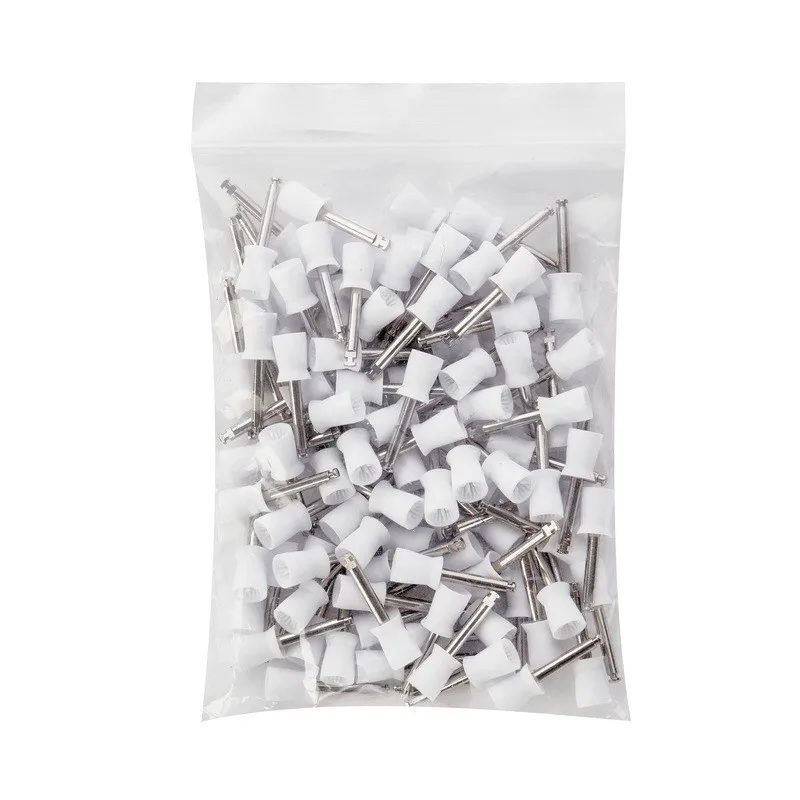
The fix: Use a new brush for every patient. Order in bulk—SinaDent offers 100 pcs per box—to keep costs manageable.
Mistake 3: Too Much Pressure
Applying heavy pressure doesn't clean better—it damages bristles and generates unnecessary heat. The bristles need to make contact with the tooth surface, not be crushed against it.
The fix: Use light, intermittent pressure. Let the rotation and the paste do the work.
Mistake 4: Wrong Speed
Running the handpiece too fast causes:
Paste splatter
Heat buildup
Rapid bristle wear
Running it too slow reduces cleaning efficiency and extends treatment time.
The fix: Follow the manufacturer's recommended speed—typically 3,000–5,000 RPM for prophy brushes. Check your handpiece settings and adjust accordingly.
Mistake 5: Skipping the Gingival Margin
The gingival margin is where plaque and stain often accumulate most—yet it's easy to overlook when focused on the broader tooth surface. This is especially true when using a cup-shaped brush, which can miss the sulcus entirely.
The fix: Switch to a cone-shaped brush for the gingival margin. The tapered design reaches into the sulcus and along the gumline without trauma to delicate tissue.
Choosing the Right Brushes
SinaDent offers both shapes in a standard RA 2.35mm shank, 100 pcs per box:
Cup-shaped prophy brushes – For routine prophylaxis and broad stain removal
Cone-shaped prophy brushes – For precision cleaning around brackets, interproximal spaces, and gingival margins
Both feature durable nylon bristles with metal handles, compatible with standard low-speed handpieces.
Avoiding these five mistakes will help you get better results from every prophylaxis appointment—cleaner teeth, happier patients, and brushes that perform consistently from first use to last.
Looking for reliable prophy brushes? Contact SinaDent for wholesale pricing and product recommendations.
RELATED NEWS
- Dental Equipment Guide for Modern Clinics – Scalers, Burs & More | SinaDent
- Dental Supplies Buying Guide – What Every Clinic Should Stock | SinaDent
- When to Replace Dental Burs – Signs of Wear & Lifespan | SinaDent
- Ultrasonic Scaler Tips Compatibility: EMS, Satelec, DTE & Woodpecker | SinaDenta
- Dental Carbide Bur vs Diamond Bur: Pros, Cons & When to Use | SinaDental
CATEGORIES
LATEST NEWS
- Dental Prophy Brushes: 5 Mistakes to Avoid | SinaDent2026-10-01
- Dental Equipment Guide for Modern Clinics – Scalers, Burs & More | SinaDent2026-09-29
- Dental Supplies Buying Guide – What Every Clinic Should Stock | SinaDent2026-09-28
- When to Replace Dental Burs – Signs of Wear & Lifespan | SinaDent2026-09-26
- Ultrasonic Scaler Tips Compatibility: EMS, Satelec, DTE & Woodpecker | SinaDental2026-09-24
CONTACT US
Name: Cassiel
Mobile:+8618320745852
Tel:+8618320745852
Email:info@sinadentmedical.net
Add:Room 207,Building 8,HongHua Road, No. 25,Gongming District, Shenzhen City, GuangDong Province.