
Industry-news
Ultrasonic Scaler Safety – Avoid Damage to Teeth & Implants | SinaDent
Ultrasonic scalers are powerful tools—but power without control can cause unnecessary damage. Over-aggressive scaling, the wrong tip, or excessive pressure can lead to enamel microfractures, cementum loss, and even implant surface damage. The good news: most adverse effects are entirely preventable.
Shenzhen SinaDent Medical Supplies Co., Ltd. supplies a full range of ultrasonic scaler tips and handpieces designed for controlled, precise scaling. Here's how to use them safely.
1. Choose the Right Tip for the Surface
Not all tips are safe for all surfaces. Using a metal tip on an implant or ceramic restoration can scratch or fracture the surface.
For natural teeth:
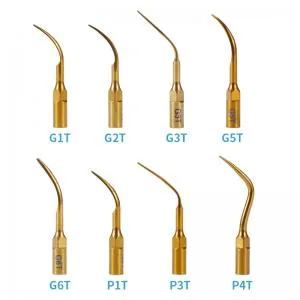
G-Series (G1T–G6T) – General-purpose tips for supragingival scaling. Safe for enamel and dentin when used with light pressure.
P-Series (P1T, P3T, P4T) – Periodontal tips for subgingival scaling. Thinner design allows access without excessive tissue trauma.
For implants and delicate restorations:
PD2L / PD2R – Left and right angle tips for furcations and narrow spaces. Use with reduced power and light pressure.
For implant maintenance: Always use a non-metal or specially coated tip. Metal tips can strip the titanium oxide layer, increasing the risk of peri-implantitis.
2. Control the Power Setting
Higher power does not mean better cleaning. Excessive power:
Generates heat that can damage pulp
Causes unnecessary vibration and patient discomfort
Accelerates tip wear
Best practice: Start at the lowest effective power setting and increase only if needed. For routine prophylaxis, low-to-medium power is sufficient.
3. Use Light Pressure
The tip should glide across the tooth surface—not be pressed against it. Heavy pressure:
Reduces efficiency (the tip stops vibrating effectively)
Generates heat
Increases risk of scratching enamel or cementum
Best practice: Use a light, feather-like touch. Let the vibration do the work.
4. Keep the Tip Moving
Holding the tip in one place concentrates energy and heat. Continuous movement prevents:
Thermal damage to pulp
Unnecessary wear on a single spot
Patient discomfort
Best practice: Keep the tip in constant motion, using overlapping strokes.
5. Maintain Adequate Water Coolant
Water spray serves two purposes: cooling the tip and flushing debris. Inadequate coolant leads to heat buildup and reduced visibility.
Best practice: Always use the recommended water flow. Check that the spray is directed at the tip and reaches the treatment area.
6. Match Handpiece to Procedure
SinaDent offers two scaler handpieces:
HW-3H – Efficient plaque and calculus removal for routine prophylaxis. Ideal for high-volume clinics.
HW-5L – Precise control and gentle scaling for sensitive patients and delicate periodontal work.
Using the right handpiece for the procedure helps maintain control and reduces the risk of over-treatment.
7. Inspect Tips Regularly
Worn or damaged tips are less effective and more likely to cause trauma. Inspect tips before each use for:
Bent or misshapen tips
Worn or rounded edges
Cracks or fractures
Replace worn tips promptly. SinaDent tips are designed for reliable performance—but no tip lasts forever.
Why Choose SinaDent?
Complete tip range – G-Series, P-Series, and PD2L/PD2R for every clinical need
Quality materials – Medical-grade construction for consistent performance
Compatible handpieces – HW-3H and HW-5L for different clinical styles
Factory-direct pricing – Competitive wholesale rates for clinics and distributors
Ultrasonic scaling is safe and effective when performed with the right tip, correct power, light pressure, and adequate coolant. By following these best practices, you protect your patients' teeth and implants—and extend the life of your equipment.
Looking for quality ultrasonic scaler tips and handpieces? Contact SinaDent for expert advice and a quote.
RELATED NEWS
- Dental Prophy Brushes: 5 Mistakes to Avoid | SinaDent
- Dental Equipment Guide for Modern Clinics – Scalers, Burs & More | SinaDent
- Dental Supplies Buying Guide – What Every Clinic Should Stock | SinaDent
- When to Replace Dental Burs – Signs of Wear & Lifespan | SinaDent
- Ultrasonic Scaler Tips Compatibility: EMS, Satelec, DTE & Woodpecker | SinaDenta
CATEGORIES
LATEST NEWS
- Ultrasonic Scaler Safety – Avoid Damage to Teeth & Implants | SinaDent2026-10-02
- Dental Prophy Brushes: 5 Mistakes to Avoid | SinaDent2026-10-01
- Dental Equipment Guide for Modern Clinics – Scalers, Burs & More | SinaDent2026-09-29
- Dental Supplies Buying Guide – What Every Clinic Should Stock | SinaDent2026-09-28
- When to Replace Dental Burs – Signs of Wear & Lifespan | SinaDent2026-09-26
CONTACT US
Name: Cassiel
Mobile:+8618320745852
Tel:+8618320745852
Email:info@sinadentmedical.net
Add:Room 207,Building 8,HongHua Road, No. 25,Gongming District, Shenzhen City, GuangDong Province.